
Cumberland Directory Collections
Most surviving Cumberland directories describe Fayetteville and nearby named communities rather than every county address. The strongest starting shelf is the North Carolina Reference and Genealogy Reference collection at the Headquarters Library. DigitalNC supplies scans and catalog records for several editions, while local historic-preservation bibliographies identify additional years. Use the volume closest to the event being researched, then compare it with an earlier or later issue. A gap in the scanned run does not mean the household disappeared.
| Directory collection | Years represented | Where it is held | How to use it |
|---|---|---|---|
| Fayetteville N.C. Directory | 1909-1910 | DigitalNC and library collections | Cataloged early alphabetical and business context. |
| Fayetteville directory | 1915-1916 | DigitalNC scan | Alphabetical, business, street, and miscellaneous sections. |
| Hill directories | 1924, 1937, 1959, 1960 | DigitalNC and Headquarters Library | Compare names, addresses, neighborhood labels, and household clues. |
| Local directory bibliography | 1909 through the 1980s | North Carolina historic-preservation report | Find published years before seeking the volume or microfilm. |
Hill Directory Company’s 1959 introduction says its Fayetteville run began in 1906. The documented bibliography includes 1928, 1939, 1943, 1946, 1948-49, 1951, 1958, 1969, and 1974-80 among the local years. Those references are useful shelf leads, not proof that each volume is online. Note: Record the printed year and edition title before comparing any two Cumberland volumes.
Cumberland’s Hill Directory Run
The 1915-1916 and 1959 editions show how the local directory changed from a name list into a practical record of the city. The earlier scan includes alphabetical, business, street, and miscellaneous departments. The 1959 volume divides its material into business and professional listings, an alphabetical resident list, a householder and street guide, and a numerical telephone section. Its introduction reports 7,631 Fayetteville residents in a November 1915 census. That figure belongs to the period volume, not to a current population estimate.
The 1959 edition reaches beyond a central Fayetteville heading. It names Bonnie Doone, Drake Park, East Fayetteville, Honeycutt, Lakedale, Lafayette Village, Massey Hill, and Myrtle Hill. Search those labels as printed, especially when a family story uses a neighborhood rather than a city address. A historical directory may list an adult resident, a firm, or a householder, but it is not a complete census or a certified identity record.
Cumberland Directory at the Library
The Cumberland Library local-history collection places historic directories beside yearbooks, maps, pamphlets, newspapers, census records, vital-record indexes, and photographs. The collection is on the second floor of Headquarters Library at 300 Maiden Lane in Fayetteville. Staff can retrieve a book or microfilm reel and help with a focused question. They do not undertake extensive family research, so arrive with a directory year, street, date of death, or other narrow fact.
Newspaper work needs the same care. The library explains that papers are not indexed for a name-only search, so a date of death or close date clue makes an obituary request workable. For an outside-county lookup, the library lists up to five copies as potentially free, with additional copies at $0.15 plus postage. Call 910-483-7727 extension 1365 for the research collection before planning a specialized visit.
See the library’s local-history collection in the source image below.
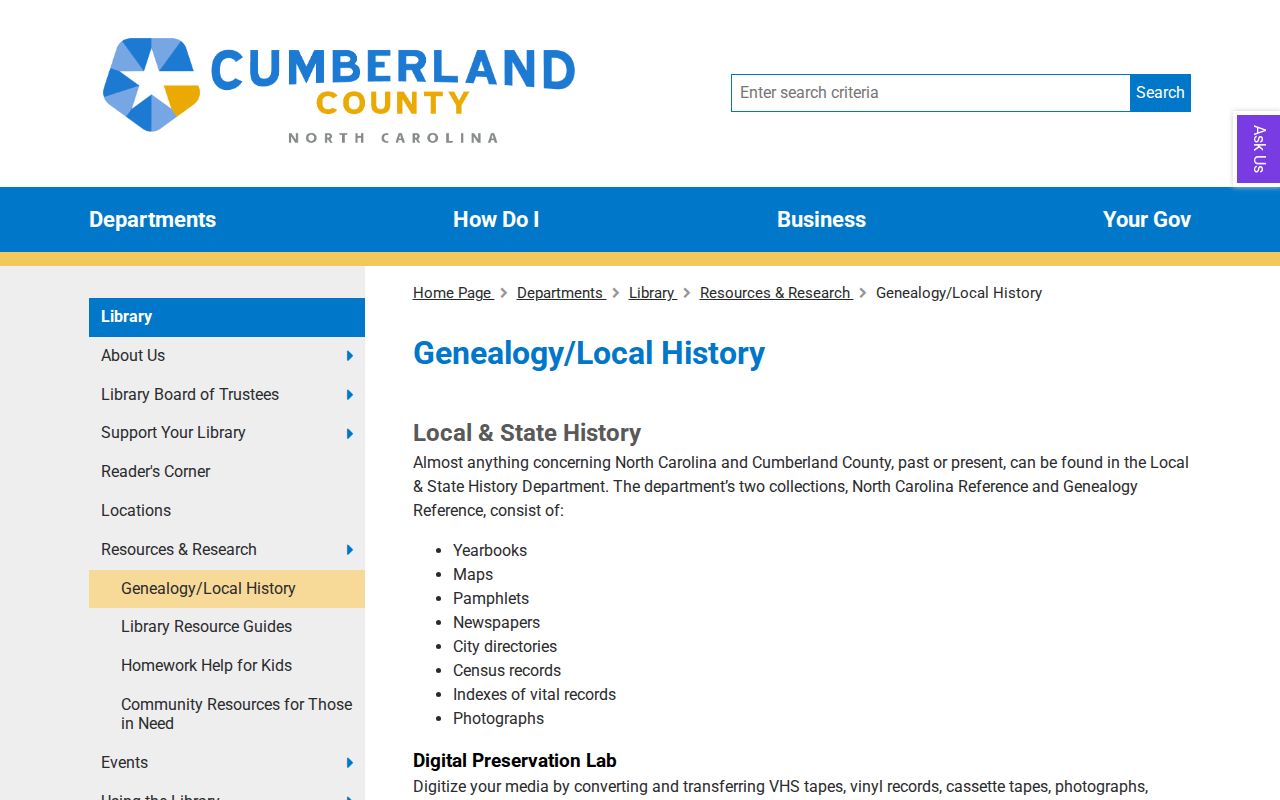
The collection is a bridge between a directory line and the maps, newspapers, microfilm, or yearbooks needed to test it.
DigitalNC Cumberland Directory Scans
DigitalNC makes several Fayetteville historic volumes practical to inspect from home. A catalog record identifies the edition and repository context. A scan provides the printed pages that must be read for abbreviations, street order, and nearby names. The 1924 Fayetteville directory record and the cataloged 1937 volume are useful for comparing interwar entries. The 1915-1916 and 1959 direct scans make it easier to move between the alphabetical section and the street guide without handling a fragile original.
The 1924 DigitalNC record is represented in this source capture.
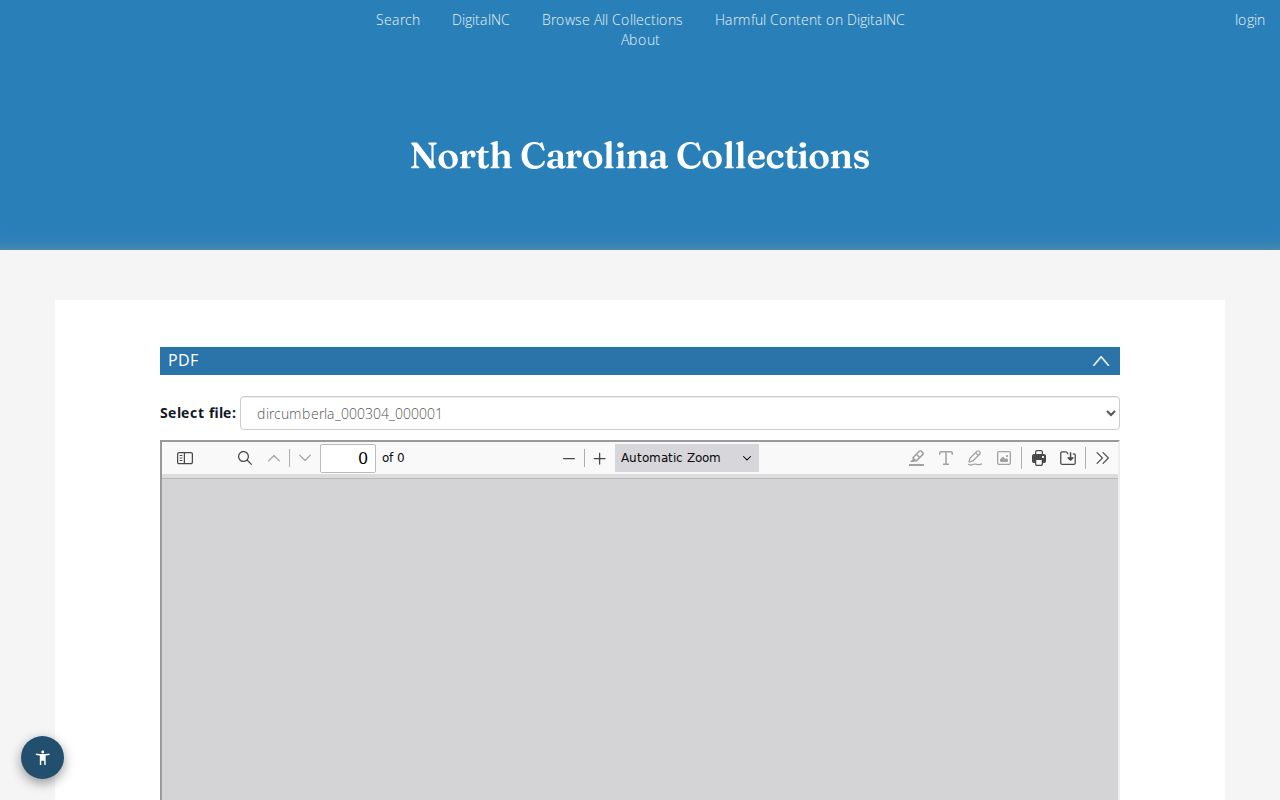
Use the catalog page to identify the edition, then inspect the image or physical volume for the exact printed entry.
Not every local year has a digitized copy. When a needed year is absent, check the Headquarters Library, the State Archives, or the bibliography before assuming it was never published. The Heritage Square Historical Society collection at FTCC Digital Archives is another local repository for digitized records, photographs, and publications. Its collection page does not promise a complete resident index, but it can add institutional and neighborhood history.
Read a Cumberland Directory Entry
A directory entry is a bundle of dated clues. Read each mark in the context of that edition’s key. The alphabetical department can provide a spelling, initials, marital-status notation, occupation, address, or business affiliation. The street guide may add an intersecting street and the household or concern opposite a number. A telephone section can confirm that the publisher placed the household under that number in the printed year. None of those fields alone proves a present address, ownership, relationship, or life event.
| Name | Record the surname, given name, initials, and exact spelling used in the volume. |
|---|---|
| Status or occupation | Read marital-status notation and work or business wording as historical text, not a current claim. |
| Address | Keep the house number, street spelling, neighborhood label, and any intersecting street. |
| Householder mark | Capture an owner or occupancy notation only when that volume actually prints one. |
| Telephone or firm | Use the telephone section or firm cross-reference as a lead tied to the edition date. |
- Criss-cross directory
- A reverse listing that moves from a street address to the householder or concern shown at that number.
- Householder index
- The part of a volume arranged around residences, streets, or householders rather than only surnames.
- Abbreviation key
- The publisher’s explanation of shortened words and symbols. Read it before expanding a mark in an entry.
Cumberland’s 1959 Directory Street Guide
The 1959 volume’s third department is a practical rescue route when a surname search fails. It lists numbered streets first, then named streets alphabetically, with residence or business numbers and householders or concerns opposite. Intersecting streets appear at crossings. Start with the old address, read the street in the printed order, and then return to the alphabetical section with the name found there. This is especially helpful with a misspelled surname or an entry filed under initials.
Fayetteville’s 1951 citywide renumbering and street-renaming event complicates a simple number match. A 1924 number can differ from a later tax card even when the building or household did not move. For a current address-keyed investigation, use the Cumberland Street Directory for the modern parcel and deed path. Keep historical numbers separate until a contemporary map, deed description, or guide supports the connection.
Note: Preserve the directory’s street spelling and number before translating it into a modern address format.
Cumberland Directory Map Clues
Fayetteville Sanborn maps add a physical check beside a directory line. The 1891 Library of Congress map record is one entry point to sheets that can show building size and shape, construction material, use, street width, property boundaries, water mains, hydrants, and house or block numbers. Historic-preservation reports also cite Fayetteville sheet years from 1885 through 1930. A directory address can then be read against a residence, store, church, school, or vacant lot.
Use a map to settle a location question, not to turn a directory address into a claim about an individual. The same number may reflect a 1951 renumbering, annexation, or older street convention. A Sanborn sheet and a dated directory complement each other because each records a specific time.
Trace Cumberland Directory Households
A household trail works best when every change is recorded before it is explained. Begin with the street, surname, town, or neighborhood actually known. Then move only one available directory year at a time. Pair the printed evidence with census years, maps, newspapers, and recorded instruments. The North Carolina genealogy guide recommends noting nearby households when separating same-name families, and the library’s yearbooks and obituary resources can supply additional time markers.
- Find the nearest Cumberland directory edition and transcribe the printed name, initials, address, neighborhood, and any street-crossing clue.
- Read both the alphabetical list and street guide, then note the owner or occupancy mark only if the volume includes it.
- Move backward or forward one edition and treat a new number as a question to check, not proof of a move.
- Compare the directory year with a census, Sanborn sheet, newspaper issue, deed, or a focused library request.
- Use the Register of Deeds, Clerk, Archives, or library to verify a key event when a historical lead needs a custodian record.
A name that vanishes may reflect a move, death, a changed spelling, an unlisted household, or a gap in the collection. The best next step is a dated source with a different keeper. A modern confirmation can follow through the Cumberland name-verification page, but it should not overwrite what the historic volume actually says.
Cumberland Directory Place Names
Cumberland’s older geography can change how a directory result is found. The county formed in 1754, and historical records can use Choeffington, Cross Creek, Campbellton, or Fayetteville for the same broad area. Cross Creek and Campbellton combined in 1778, and Fayetteville became the name in 1783. Search the place wording used by the record, then keep a modern label in a separate note. This prevents a current map label from erasing the source’s own geography.
The 1831 Fayetteville fire burned much of the city, so survival of older material varies by office, volume, and record type. That is a records-history caution, not a reason to assume a missing name never existed. The State Archives, library microfilm, and historic maps are sensible next channels when a directory does not reach far enough back.
The library also provides house-history support through its local-history resources.
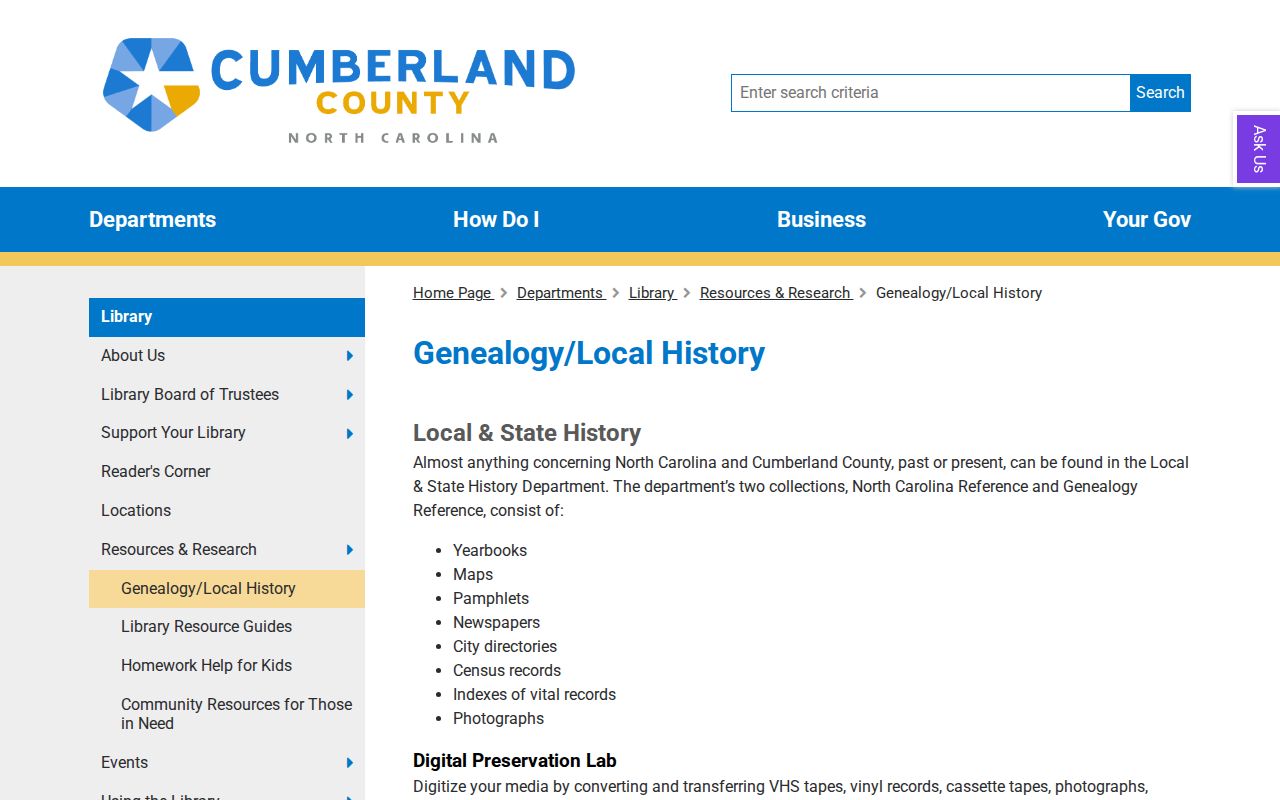
A focused street, year, or neighborhood gives staff a workable starting point for a historical collection request.